How to Manage Drawdowns
Should I cut, add, or just wait it out?

Dealing with a large drawdown can feel like a death. A death of a future you saw around the peak whether it was professional aspirations, life changing money, or personal validation.
It’s in tough situations where true character (and process!) is found - this point is often mistakenly interpreted as HODL no matter what but a sign of good character is also being able to admit that a view was wrong.
Your character doesn’t need to be one-dimensional. I have personally worked with and seen many traders that make a great contrarian call, feel vindicated for riding out the hate and doubt, and invest solely in contrarian views for the rest of their life often to their trading detriment. I get it, we all want to be different, but honestly, wouldn’t you rather just make money?
I have made many trading mistakes in my career. When I first started trading in college, I blew up my account multiple times using too much leverage. The lessons I learned from that set me up for a decade plus career across Wall Street and Europe managing options books and multi-billion dollar portfolios across a range of strategies. But, I still make mistakes and I’m still constantly learning.
Following a process is easier said than done. I’ve written some of the things that I have learned along the way that hopefully some of you may find useful.
Your Best Trades Can Come After Your Worst
Lord Fed wrote a piece about how people’s best trades are often followed by their worst. I find this particularly true for those who have made a great contrarian call. But, I would also say that for some people, their best trading comes after their worst because they choose to adapt. Here are some early career drawdowns that helped pave the way for success:
Ray Dalio’s hedge fund Bridgewater lost everything to the point that Dalio borrowed money from his dad to cover living expenses before going on to become the largest hedge fund in the world. He constructed an entire formal set of principles that dictated his trading going forward.
Charlie Munger’s partnership lost 50%+ from 1973 to 1974 before recovering in 1975 and he joined Berkshire not too long after (via merger). He realized he hated managing the money of people that he personally knew during drawdowns, which pushed him toward the Berkshire model of permanent capital (shareholder structure with no forced redemptions).
Paul Tudor Jones (PTJ) lost around 70% on a single trade in 1979 before going on to found Tudor Investment. He began to focus on risk control and position sizing.
There are many more examples but I chose these three because they each have a unique approach to the market.
Dalio is known for a semi-systematic approach to isolating alpha and handling risk management through holding many positions that are sized with respect to position volatility and correlation.
Munger has a deep value approach and has stated “if you're not willing to react with equanimity to a market price decline of 50% two or three times a century, you're not fit to be a common shareholder, and you deserve the mediocre result you're going to get”.
PTJ runs a discretionary macro approach and has stated “Don't focus on making money; focus on protecting what you have” and is known for hanging up the quote “losers average losers” in his office, the view that continuing to average down in a losing position is a recipe for disaster - a takeaway from his 1979 drawdown.
All three of these investors would manage drawdowns differently. One would rebalance the portfolio, another would be indifferent, another would cut at the first sign of a view potentially being wrong.
Your risk management approach needs to fit your investing style. Munger’s approach would never work in a hedge fund setting. PTJ’s approach would be a poor choice for a deep value investor.
What is your Edge?
To determine the risk management approach to suit your investing style, the first question to start with is what is your edge? If you don’t know the answer to that question then you probably fall squarely into the camp of average retail investor - and that’s not a slight.
The starting edge that all retail investors can have is permanence of capital - in other words, freedom from drawdown limits and forced selling. I say “can have” because many retail investors give up this edge by:
Trading with cash that needs to be spent soon which imposes a drawdown limit
Trading with margin which can require forced selling
The old adage that Time in the Market beats Timing the Market goes hand in hand with this.
Every hedge fund wishes that they could tie up their capital for longer - not just to lock in fees but because redemptions often come at the worst time and force you out of good positions. Millennium, Citadel, and D.E. Shaw are examples of funds locking capital up for longer which their strong performances have allowed them to do.
If your edge is deep research, then tolerating a larger drawdown limit makes sense. If your edge is that you are great at spotting a bunch of short-term emerging trends on social media, then tighter drawdown limits make sense because you want to be able to keep repeatedly rolling the dice with a smaller edge.
You shouldn’t run a Munger-style No Drawdown Limit risk management system without the Munger-style deep research.
If you’re investing off a tweet or a few paragraphs in a Substack article, then you’re likely never going to know when to sell. Do you actually have high enough conviction to hold or are you just rationalizing not taking a loss? Only continuous deep research allows you to find that conviction.
If your timing isn’t luckily perfect then you will inevitably find yourself in a drawdown at some point due to natural volatility which raises the chances that you cut due to pain. And it’s unclear whether you’re cutting a good position or a bad position.
There is academic research that supports this - investors give up much or all of their alpha on exit decisions even if they are capable of identifying alpha.
“While there is evidence of skill in buying, selling decisions underperform substantially, even relative to random-selling strategies.”
A textbook mistake I see (and have experienced myself) is when you put on a short-term tactical position, it goes into drawdown, and then you tell yourself you don’t need to cut it because you plan on holding it for years because your conviction is so high (when in reality it was just a short-term trade with some conviction). What was supposed to be a 15% PnL trade slowly becomes 50% against you.
If you’re still trying to determine what your edge is, I would recommend reading the book Hedge Fund Market Wizards by Jack Schwager as a starting spot for inspiration. He interviewed some of the best investors where they discussed edge, risk management, position sizing, and more. There are two books in that series and both are worth a read. Pay attention to which investors actually continued to perform well and which ones didn’t.
How Much Are You Willing to Lose?
When managing positions in a drawdown, you first need to understand what your drawdown could become. Ken Griffin recently said this on a Goldman Sachs podcast:
“You’ll never manage a portfolio for every possible tail event. But you should stay very focused on, like, what is the worst-case scenario? Can I tolerate that loss? And monitor and maintain your exposures such that that loss is a tolerable loss. It may be an extreme loss. But it’s still tolerable.”
If you don’t understand what your potential drawdown is, you may end up cutting a position at the worst possible level before you can see your investment thesis through because you sized it too large (recall Munger’s quote that multiple 50% drawdowns in your career should be expected). This problem becomes even more acute when trading with margin. But even when you’re not trading with margin, you may end up cutting when the pain of a drawdown becomes too large to bear. If you use pain as your risk management system, market volatility will bleed you dry over time.
To avoid using pain as a risk management system, first have a strong understanding of how big your drawdown could be.
So start with, what is the worst price I can see this investment getting to?
Another way to frame this is, at what price do I believe that my investment thesis is invalidated?
Someone like Munger might argue that the thesis is never invalidated due to price action. In that case the worst price they see for the investment would be based on extreme market volatility.
Someone like PTJ might tell you price is the source of truth. In that case the worst price is the thesis-invalidation level - the level at which you would take off your trade.
Decide which style and viewpoint aligns with your own.
After establishing what the downside price level is, measure the loss of your position at that level and ask yourself if it’s tolerable. If it’s not, that doesn’t necessarily mean the investment is wrong, but that your position sizing is likely incorrect.
What is the worst price though?
There are different methodologies for arriving at the downside price level. Some practitioners use VaR-based models, some use sVaR, some use Monte Carlo simulations. This could be an entire book on its own but my brief personal take below:
How I trade professionally in an institutional setting differs from how I trade my personal portfolio. In my personal portfolio for equities, I try not to give up the advantages I have as a retail trader - primarily that my drawdown limit can be larger.
I consider what levels would be considered historically extremely cheap based on fundamentals (value-based approach), psychological levels (where has this traded before), and thematically (if my entire view on AI is wrong, what breaks).
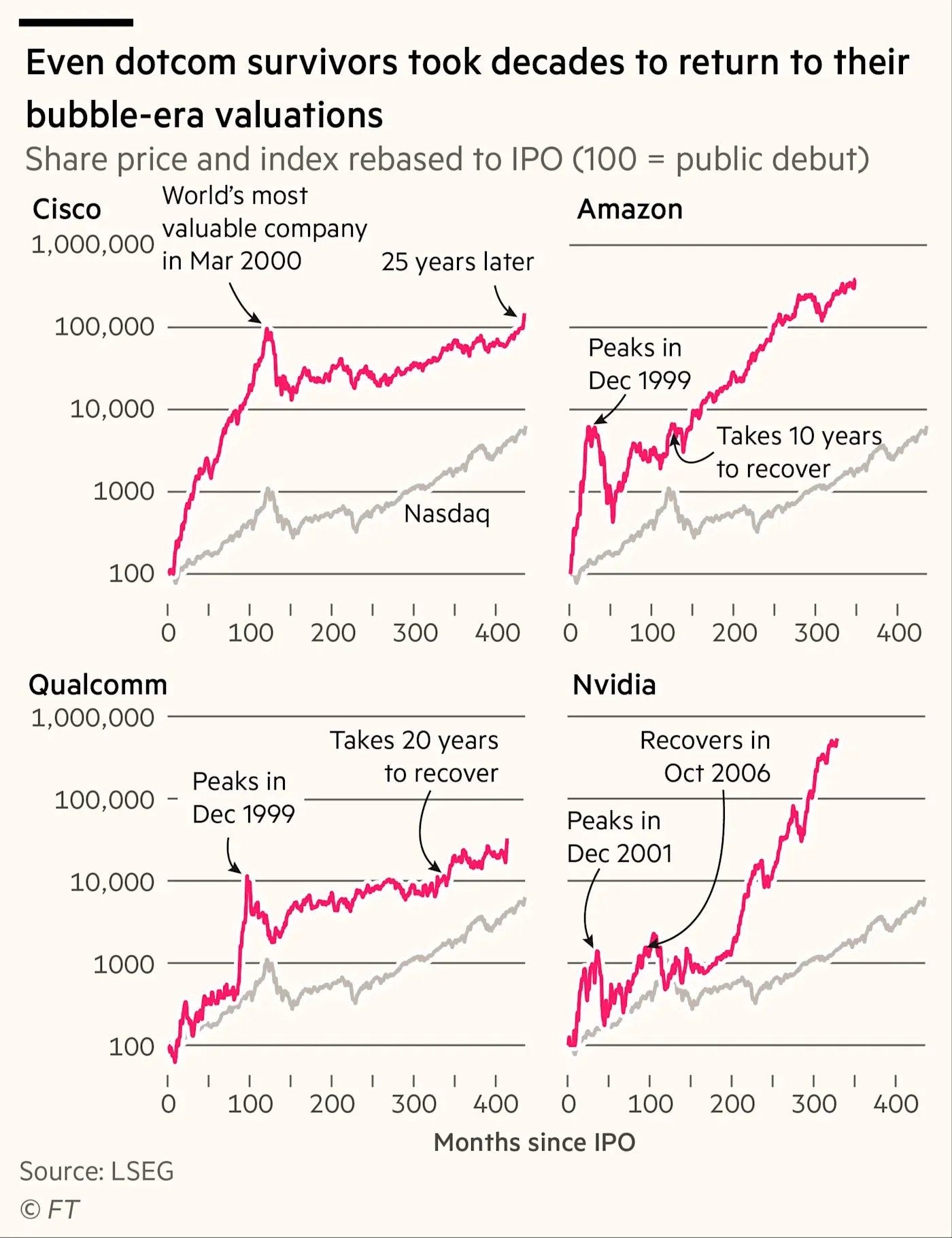
In this cycle, many AI stocks are pricing in many multiples of their revenue meaning they are a growth story and the current fundamentals don’t give it much support. Many also aren’t profitable and need to borrow to fund their operations which means more possible dilution. If you’re holding a stock like this it doesn’t necessarily mean it’s bad, but your drawdown could be significantly larger.
Keep in mind, that there needs to be a marginal buyer - who is willing to step up to support the price? In a small cap AI stock without much analyst coverage, institutional funds are very unlikely to come in and buy the dip meaning that it’s prudent to allow for a larger price fall in your analysis.
How much you pay for future revenue matters when we hit volatility. I’m not saying we’re in an AI bubble and that it’s popping now. But what I’m saying is, it is essentially a certainty that there will be periods of high volatility and drawdowns so don’t forgo your fundamentals.
What actually is the thesis invalidation level?
Two ways to think about this.
Sometimes you really like a trade but you don’t necessarily love it. I sometimes think of a thesis invalidation level as a commitment test. If your partner were to move abroad would you do long distance? If this trade started to drop 25% and could drop 50% do I really love it enough (strong enough conviction) to hold through a drawdown even if nothing in my thesis has changed? If the answer is no, I puke a position sooner rather than later.
Another way to think about this is choosing a level that you know would cause you to doubt the position - either the level is one you never expect it to get to if your view is correct or one that would require you to lose more than you were willing to on this trade (a de facto stop loss).
How much should I be willing to lose?
Only you know the answer to this but your loss tolerance should take into consideration your target return. If you’re aiming for a 100% return but can only target a 20% drawdown, it’s highly likely you’re going to hit your stop loss before you hit your return target.
If you keep finding that you frequently hit 50% drawdowns on trades you’re trying to make 25%, it’s worth rethinking your entry and exit levels.
Position Sizing is Drawdown Management
If you understand your exit price / risk tolerance in advance then you are able to position size accordingly so that you can hold (the right trades) through major drawdowns. This gives you a chance at building a repeatable process that will survive the decades of the market’s ups and downs.
In order to decide to cut, add, or hold you first need to understand your drawdown levels and position sizing. If you don’t then you don’t know how much you are reasonably capable of adding or if you’re holding a position that’s already too large that has a high chance of potentially being cut purely due to pain. The latter is more akin to gambling than investing and the odds aren’t in your favor over the long run.
Without consistently doing this risk management exercise, you may have been conditioned on some early wins that buying the dip or HODLing always works out. But if you take that all in mentality, you are likely to eventually blow up. It only takes a single wrong view or volatility event to wipe you out - that was the harsh lesson that PTJ learned.
Trading in that manner is essentially a short volatility strategy - it works most of the time until it doesn’t. Your PnL profile goes up and up for many years and then a single bad volatility event takes it all back.
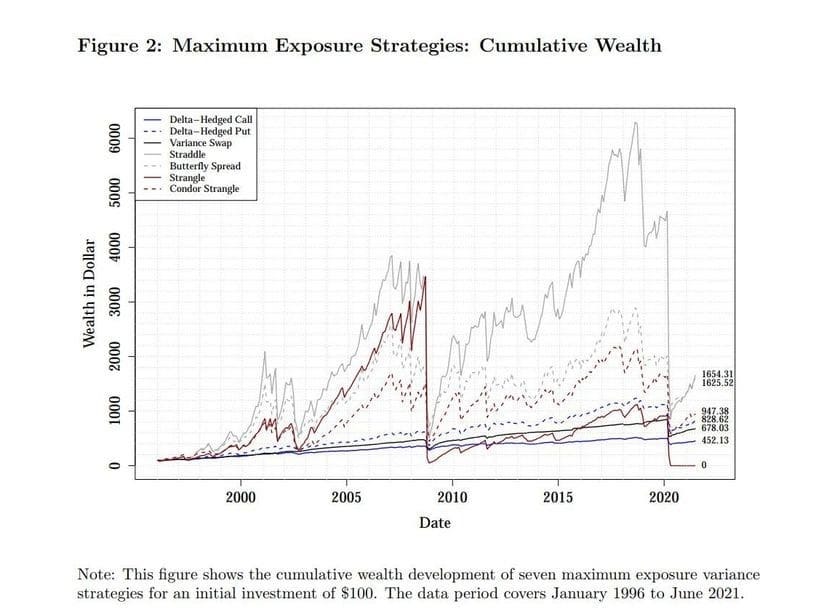
You may have come across Kevin Xu on X who has self-proclaimed hitting $10m through full-port swing trading - there is a reason that he doesn’t do this anymore. Oversizing your trades comes with a high chance of ruin and is a de facto short volatility trade. For every Kevin Xu out there, there are many more that have hit 0 before taking risk off the table. Just go to the Loss tag on Reddit’s WallStreetBets.
If your HODLing isn’t a product of deep, intensive research, the same mentality that allowed you to ride out all the volatility on the way up is the same mentality that can have you riding it all the way back down.
Weighting by Conviction AND Asymmetry
Particularly if you are actively trading, then you need to weight your trades by conviction. You don’t need to convince yourself that every trade you put on is The One.
In the professional active investing space, nearly all traders sit close to a 50/50 win-loss ratio. The key is making sure that your wins really win and that your losses are kept manageable. The cautionary quote to the inverse of this is “don’t pick up pennies in front of a steam roller”.
Even if your strategy is a longer term buy and hold, weighting by conviction and asymmetry can make significant differences.
A quote from one of Warren Buffett’s Partnership letters:
“We might invest up to 40% of our net worth in a single security under conditions coupling an extremely high probability that our facts and reasoning are correct with a very low probability that anything could drastically change the underlying value of the investment.
[...]
The question always is, How much do I put in number one (ranked by expectation of relative performance) and how much do I put in number eight? […] It also depends upon the probability that number one could turn in a really poor relative performance.”
The key aspect that I think gets missed by many investors is that you shouldn’t just size based on conviction but also asymmetry. Higher conviction means larger sizing. Higher conviction and higher asymmetry means even larger sizing. A mathematical formalization of this is the Kelly Criterion formula. Many traders use a Fractional Kelly approach. (On a portfolio level, think about the relative sizing amongst your positions based on conviction and asymmetry.)
Simply stated, as the price changes your asymmetry changes even if your conviction remains the same. The potential upside of a stock becomes smaller as the price of a stock rises while your potential downside becomes larger.
Sometimes when I buy a stock, I say that I sized it like an option. What that means is, I believe that there is a high chance of drawdown, but also a high chance of a big rise. For stocks, the downside is that the price goes to 0.
Suppose the stock I’m looking at is highly levered, small cap, etc. so there is a realistic chance it could drop 80%+. But, I do see a scenario if everything worked out for this stock that it could be worth multiples more. Any stock like that is likely to be highly volatile and if I use any sort of leverage or oversize it there’s a decent chance I puke the position in any sort of volatility event. But, if I size it and think of it like an option, it gives me a chance to be able to hold through volatility and get outsized returns.
How many “options” you hold in your book depends on your risk tolerance, but don’t mistake more positions necessarily for more diversification.
Too Late, What Now?
You might be reading this and saying to yourself, this is all great but these are all mostly things to do before putting on a position.
To that I would say, to determine whether to hold, cut, or add ask yourself these questions and run these exercises first:
What’s my tolerable downside scenario?
Assess this on each position - what’s the downside price or the thesis invalidation level. If you want to be more risk averse, assume that there is no diversification benefit to holding multiple positions i.e. stress all of the positions independently and add the potential losses together.
If you’re currently holding 5+ positions in the AI space that are all up 100%+, it’s likely that you have high beta to a theme i.e. not much diversification benefit.
If you’ve determined that your risk exposure is too high, ask yourself which you prefer: Reducing a small portion now in order to be able to hold my position longer-term through more volatility OR Risk getting stopped out at a level at which I would buy hand over fist but potentially missing out on upside gains.
What is your thesis?
For each trade, write down why you initially invested and what has changed since then. Rate your conviction level and how asymmetric you view each trade from the current price.
Are your positions both relatively and absolutely sized properly by conviction and asymmetry? If not, consider rebalancing. Cutting good positions to hold onto bad ones is the inverse of this.
Analyze your returns to understand your potential losses.
When you’re making money it’s easy to let your foot off the pedal and coast. You stop doing your due diligence and you start making less thought out trades (this is the best trade followed by your worst setup).
Are you making money through alpha or beta? Is everything in the sector going up indiscriminately? Am I genuinely outperforming because fundamentals are backing up my stock selection or do I just have a high beta trade because the company is levered, small cap, popular on social media, etc.?
What does my post-change portfolio look like?
Holding cash is a position in itself. Are you trying to remove market exposure completely or just exposure to a theme?
If you make changes to your portfolio, keep in mind that your portfolio exposure is changing. A position that you take off may have been acting as a hedge against another position (something we have seen in the momentum/growth to value/quality rotation that’s been happening).
Talk to someone / Write it out.
Sometimes it’s literally just stating your thoughts out loud that gives you more clarity. This holds for both your thesis and the thought flow behind an impending decision.
Analyze your sources of information.
Am I getting a biased social media feed? Do the authors I follow have a thought out approach to stock selection, position sizing, and risk management or do they selectively pick the few out of many stocks that do well when the market is rallying?
If your approach to research and news is the social media feed, unless you spend a lot of time curating, you will find yourself getting sucked along with the crowd and headlines. Try to follow some independent voices and a more methodical way of analyzing the markets and the economy.
Ground your physical state.
Don’t forget about the physical side. Healthy body, healthy mind. For me cold exposure works wonders and refreshes my mental state. There are some studies that cold exposure works better for men but isn’t as beneficial for women so that is something to consider - do what feels good for you. If you’re constantly checking the market in a panic, you should ground yourself first before making any decisions. There are plenty of other grounding techniques out there as well for the cold-averse.
What I’m Doing
I cut most of my risk about a month ago (June 18th) but I found it extremely difficult because I still believed (and do believe) in growing inference needs but I had lower conviction in the asymmetry.
I evaluated each position by looking at what the next year of fundamentals looked like and at what price level each would be fundamentally cheap (i.e. at what level would I definitely buy). I compared that to how much remaining near term upside I saw on the trade and reduced/cut the ones with the least asymmetry. I then broadly reduced all remaining positions in order to express my lowering conviction as talks of open source and Chinese LLMs became more prominent.
Admittedly, I did FOMO back into some small clips of positions that I had cut completely - a process is always easier talked about than executed.
I believe that we will start to see more differentiation going forward of winners and losers within the AI bucket rather than the highly correlated price action that we’ve seen so far within the complex. Overall I believe that there are still great opportunities in the market.
My latest pieces from last month where I discuss why I took off risk can be found below and I will be posting my updated thoughts soon.
Dalio survived by systematizing, Munger survived by taking capital that let him ride out large drawdowns, and PTJ survived by cutting losers quickly. Find your edge and develop the risk management system that suits it.
If you’re going through a tough time, I believe you’ll find your way through. Just keep doing the hard work. Best of luck, everyone.


My macro deep dives, stock specific analysis, and personal positioning is usually paywalled and prices will continue to rise over time to reward my earliest subscribers. If you want to be the first to see them or support my work in general please consider upgrading to a paid subscription. Students get 50% off - please use this link.
Thank you for your transparency and thoughtful approach to trading. As a beginner, I really value that you present multiple sides of an argument as I’ve definitely gotten lost from authors that mainly present a bull/bear case. I’ve learned a lot from the context that you provide. Please keep up the good work as I always look forward to reading articles like this.